Pointillist render of the Amazon Spheres interior, reconstructed from a 300-million-point LIDAR scan

South Lake Union · Seattle · 2023

Seeing
with Computers.

A building reconstructed from three hundred million points.

A LIDAR scan of the Amazon Spheres, rendered point-by-point in Blender and shown on three body-controlled stations placed across Amazon's South Lake Union campus.

300M+ Points captured
3 Mobile stations
65 OLED per station

Three hundred million points of attention.

A 2023 interactive exhibit by artist Joshua Borsman, built from a LIDAR scan of the Amazon Spheres and installed on three body-controlled stations across Amazon's South Lake Union campus.

The Amazon Spheres in downtown Seattle hold a tempered rainforest under three glass domes — forty thousand plants kept at greenhouse temperature and humidity, on a city block. In 2023, working from Ground Floor Studio across the street, Joshua Borsman set out to scan the whole building.

The instrument was a Leica BLK LIDAR scanner. A LIDAR scanner doesn't take pictures; it measures distance, sweeping a room with infrared pulses and logging the position of every surface they return from. Over several sessions, captured after hours with the permission of Spheres lead horticulturalist Ben Eiben, the building became a file: 300,000,000 points in three-dimensional space, each tagged with the RGB colour the scanner had seen at that point.

That file became the work. Fly-throughs were rendered in Blender, lit and graded frame by frame — not photographs of the Spheres but pointillist reconstructions made entirely from the captured data.

Three mobile stations were built to show them. Each one paired a 65-inch OLED with a custom PC and a Microsoft Azure Kinect DK depth camera that watched the room and tracked the viewer's body. The cameras inside the renders were tied to the cameras outside them: step to the left and the virtual camera moved left; lean in, it leaned in. The work was meant to be walked around, not watched.
300M+
Points captured
3
Mobile exhibit stations
65
OLED display per station
Frames rendered by hand

The Subject.

Three intersecting glass domes in downtown Seattle, holding more than forty thousand plants from over four hundred species at rainforest temperature and humidity. Opened in 2018; designed by NBBJ.

The interior of the Amazon Spheres — spiral staircase, living wall, geodesic glass dome
Interior planting and tree canopy of the Amazon Spheres
Tempered rainforest · interior canopy
Planted bed, mossed stones and ferns inside the Spheres
Plant beds · understory ferns

Geodesic, transparent, full of weather.

The Spheres are two architectural forms rarely set next to each other: a geodesic dome and a greenhouse. The structural geometry shows itself everywhere — every joint, every cable, every pane of glass — which is what made it a useful subject for a LIDAR scanner. A point cloud needs surfaces to bounce off, and the Spheres have almost nothing else.

LocationDowntown Seattle, WA
FormThree intersecting geodesic glass domes
ArchitectNBBJ
Climate72°F, 60% relative humidity
Plants held40,000+ across 400+ species
Opened2018

The Scan.

A Leica BLK on a tripod, moved by hand through the Spheres after closing time. Each position records a hemisphere of distance measurements; the captures are stitched into a single cloud later.

Leica BLK LIDAR scanner mounted on tripod, mid-capture inside the Amazon Spheres
Capture session · tripod-mounted LIDAR
Step 01

Walk the route

A capture path through the Spheres, planned around the plants and the pinch points. The scanner is moved by hand from station to station.

Step 02

Pulse, return, record

From each station the scanner sweeps a full hemisphere of infrared pulses, logging the distance and angle of every surface they bounce off, alongside the colour the onboard camera saw in the same instant.

Step 03

Register the cloud

The individual captures are aligned in software and merged into a single point cloud. Drift is corrected manually where the software guesses wrong.

Step 04

Hand off to the renderer

The cloud is exported and imported into Blender as raw point data, ready to be lit, framed, and animated.

The Render.

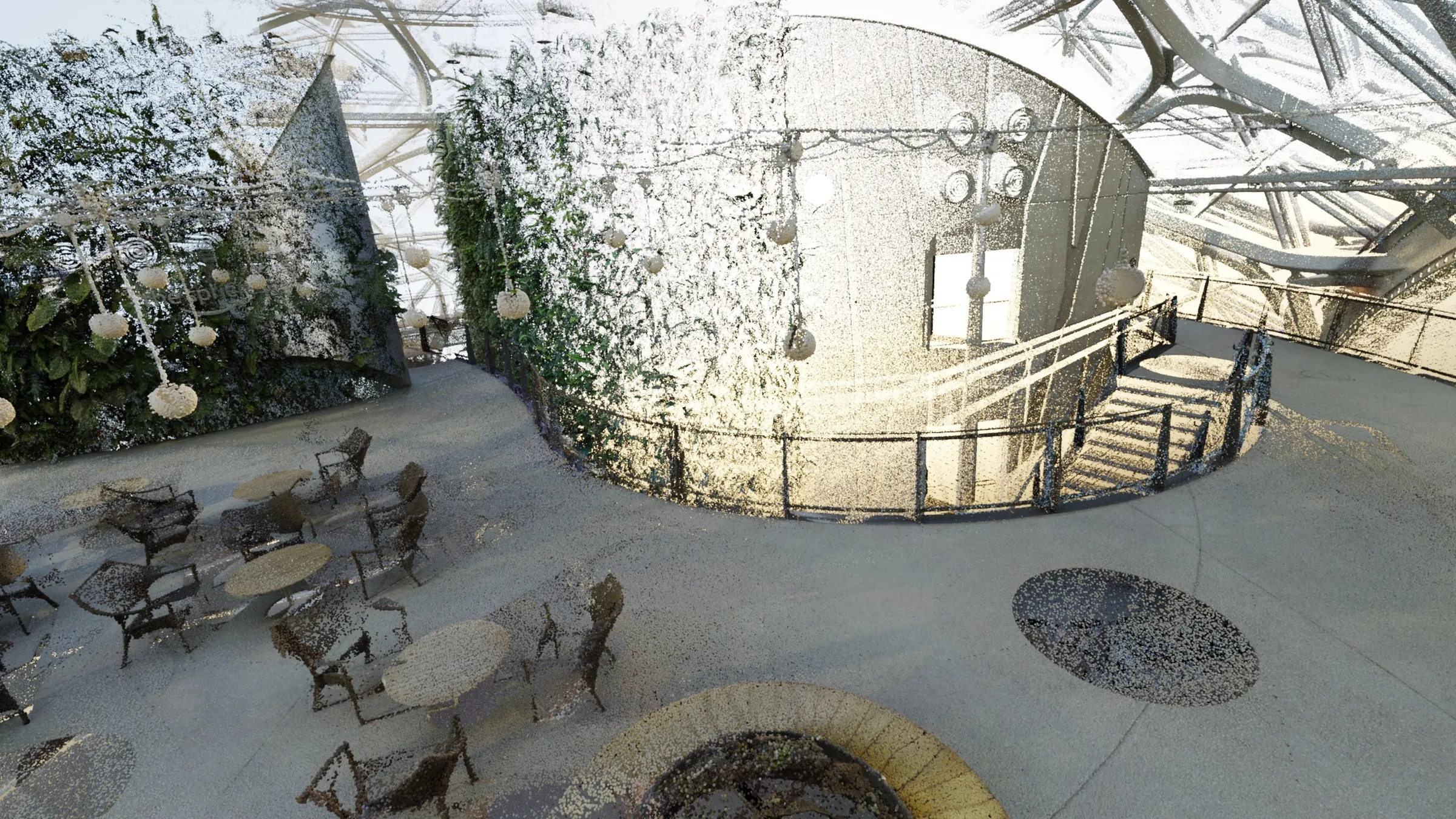
The renders use the point cloud directly — no surfaces, no meshes, no textures, just the captured points as the smallest visible elements. Each frame was lit and graded in Blender by hand.

Pointillist render of the Amazon Spheres interior — chairs and hanging orbs in the canopy
Wide overhead point cloud render of the Spheres interior
Pointillist render at floor level — chairs and tree base, fog of points
Interior render — railings and floor pattern dissolved into points
Close render of the Spheres' living green wall — vines pressed against geodesic frame

A wash of magenta and rose.

A second render pass dropped the RGB the scanner had recorded and re-coloured every point by its height in space. The point is the same; only the light is different. From above, the three domes resolve into a clean overhead diagram.

Top-down magenta-toned render of the Amazon Spheres — three domes from directly above
Still frame from the wordmark zoom render
Camera zoom · the wordmark, materialising from points
Still frame from the dome fly-through render
Exterior fly-through · the dome dissolved into points, 50 seconds, looped

The Build.

Three identical machines, three identical platforms — chassis, cooling, GPUs, OLED panels, casters — built from scratch in the Ground Floor Studio workshop.

Drawn before it was built.

The cart was designed in CAD before any material was cut. A solid-core door for the base, an aluminium 80/20 mast bolted up through it, a 65-inch OLED at the top, the PC and soundbar tucked into the base, and the Azure Kinect DK mounted at roughly chest height where it could see a person standing in front of the screen.

Heavy-duty casters under everything. The stations were meant to roll through service corridors, into lobbies, between elevator banks. The exhibit went to the audience.

Industrial design drawing of the mobile exhibit cart with annotated components — 65-inch display, custom PC, depth camera, speaker, mobile base

Three custom PCs.

Three identical builds, each one a Thermaltake Tower 100 chassis with an Intel Core i7, an NVIDIA RTX 3090, 196 GB of DDR5 and fast NVMe, kept cool by a be quiet! tower. Specified to drive a 300-million-point cloud at 4K, in a sealed cabinet, in a public lobby, all day.

Three sets of PC components laid out in their boxes — chassis, GPUs, coolers, fans, SSDs, CPUs
Components · three identical builds
Three completed PC towers on a workbench in the studio
Assembled towers · before paneling
The interior of one PC build — GPU, motherboard, cooling stack visible

Cabling, cooling, panels off.

Each build was specified to drive 4K at sustained 60 fps for hours at a time in a closed lobby — a real-time render of a 300-million-point cloud, all day, every day. The cabinets stayed sealed once they hit the floor; nothing was meant to break.

Three door-desks.

The base of each station is a solid-core door, a nod to Amazon's Door Desk: the desks built from doors that Jeff Bezos used in the company's early years, and that Amazon has kept around since as a frugality symbol. Putting the artwork on top of one felt right for a piece installed across the company's campus.

Two candidate casters side by side on a workbench
Caster selection · soft tread vs hard
Three completed solid-core door platforms on casters in the studio
Three door bases · rolled, ready

On the mill.

The mast that carries each screen is a length of 8020 aluminium extrusion bolted to a steel base plate. Cross-members and base plates were drilled and tapped in-house on the Haas Mini Mill that arrived during the Ground Floor Studio build-out and lived on the workshop floor for the rest of the year.

A bundle of cut 8020 aluminium cross-members standing on the workshop floor in front of the Haas Mini Mill, queued for drilling
Before · cross-members queued for the mill
An 8020 aluminium mast joined to a steel base plate via threaded studs — the drilled and tapped result
After · base plate threaded to mast
Still from the mill drilling a base plate
Drilling a base plate · coolant flowing
Still from the tool changer mid-cycle
Tool change · tapping the mast holes
Joshua aligning the aluminium extrusion mast on a solid-core door cart base
Aluminium mast · alignment on the bench
Three door-base carts each carrying a vertical aluminium mast — fleet in progress
Fleet · three masts up
Three boxed Sony A80K 65-inch OLED displays delivered to the studio

The viewer becomes the camera.

The Azure Kinect DK combines a time-of-flight depth sensor and an RGB camera in one small block. On each station it ran a body-tracking pipeline and fed the position of a single viewer to the PC, which used that position to drive the virtual camera inside Blender. Step left, the virtual camera moved left; lean in, it leaned in. Nothing to hold, nothing to click — the picture you saw was always a function of where your body happened to be.

Test station in studio — Azure Kinect depth sensor on a tripod, paired with custom PC and a monitor running the point-cloud render of the Spheres

Per-station specification · Build, summer 2023

DisplaySony A80K OLED · 65″ · 4K · self-emissive
ComputeCustom build · Thermaltake Tower 100 · Intel Core i7 (12th gen) · NVIDIA RTX 3090 · 196 GB DDR5 · NVMe
CaptureLeica BLK series LIDAR scanner · tripod-mounted · 300M+ points
SensingMicrosoft Azure Kinect DK · time-of-flight depth + RGB · sub-cm body tracking
RendererBlender · custom point-cloud runtime · 60 fps target
AudioSoundbar · stereo · ambient bed
BaseSolid-core door · birch ply face · aluminium 80/20 extrusion mast · heavy-duty casters
LineageThe door references Amazon's Door Desk, the company's longstanding frugality symbol
Footprint~4 ft × 2.5 ft, rolling
QuantityThree identical stations

The Exhibit.

The three stations were placed in Amazon office buildings across South Lake Union — between elevator banks, beside coffee bars, in glass-walled lobbies — so that the work would meet people on their way to and from their desks.

The three completed exhibit stations lined up in the studio, each PC driving an NVIDIA RTX 3090 to render its own point-cloud frame of the Spheres in real time
A single finished station displaying a point cloud render of the Spheres dome
Single station · render running
A completed station on the workshop sawhorses before install — TV mounted, PC and soundbar fitted, screen dark
On the bench · finished, screen still dark
The installed exhibit on campus, beside an A-frame placard reading 'Joshua Borsman — Seeing with Computers'
The exhibit in a glass-walled lobby, dark drape backdrop, render glowing on screen
Installed · curtained alcove
The exhibit installed in an office lobby with planters and seating visible
Installed · public lobby, midday

Colophon.

The exhibit was part of Ground Floor Studio, Joshua Borsman's year-long artist residency on Amazon's South Lake Union campus, in partnership with Amazon GREF.

Joshua Borsman

Artist · Engineer

Sculpture, sound, and kinetic work — staged in galleries, gardens, sidewalks, and orbit. Founder of Ground Floor Studio. joshuaborsman.com

  • Studio Ground Floor Studio, South Lake Union, Seattle
  • Partner Amazon Global Real Estate & Facilities (GREF)
  • Subject The Amazon Spheres, Downtown Seattle
  • Capture Leica BLK series LIDAR scanner (courtesy of Colin Jankel), tripod-mounted, summer 2023
  • Render Blender, custom point-cloud pipeline
  • Compute Three custom PCs, hand-built in studio
  • Display Sony A80K 65″ OLED, ×3
  • Sensing Microsoft Azure Kinect DK, sub-centimetre body tracking
  • Base Solid-core doors, an homage to Amazon's Door Desk tradition

To Ben Eiben, lead horticulturalist for the Spheres, who opened the doors after hours so the scanning could happen without disturbing the building's daily public life — and to the wider Amazon Horticulture Team who look after the rainforest the rest of the time.

To Colin Jankel, Amazon engineer and fellow tinkerer, who lent the Leica BLK scanner and worked every capture session alongside Joshua. The scan, and so the work, does not exist without him.